32-Page Prepress Layout: Signatures for Books and Catalogs
Master 32-page prepress with this complete guide to signature layouts for books, catalogs, and magazines. Learn fold sequences, page placement, perfect binding setup, and creep compensation.
Why 32-Page Signatures Matter in Book Production
The 32-page signature is the workhorse of commercial book and catalog printing. It is the largest standard signature size used in production, created by printing 16 pages on each side of a large press sheet and folding it four times. Understanding how 32-page prepress works is essential for anyone involved in book design, prepress, or print production — it is the foundation that makes large-scale book manufacturing economical.
A 256-page novel, for example, is typically composed of eight 32-page signatures, gathered in order and bound together. Each of those signatures started as a single large sheet of paper, printed on both sides with 16 pages per side in a precisely calculated arrangement. After four successive folds, the pages fall into perfect sequential reading order. The elegance of this system — developed over centuries of printing history — is that a complex 32-page sequence can be produced from a single sheet, minimizing press time, paper waste, and binding labor.
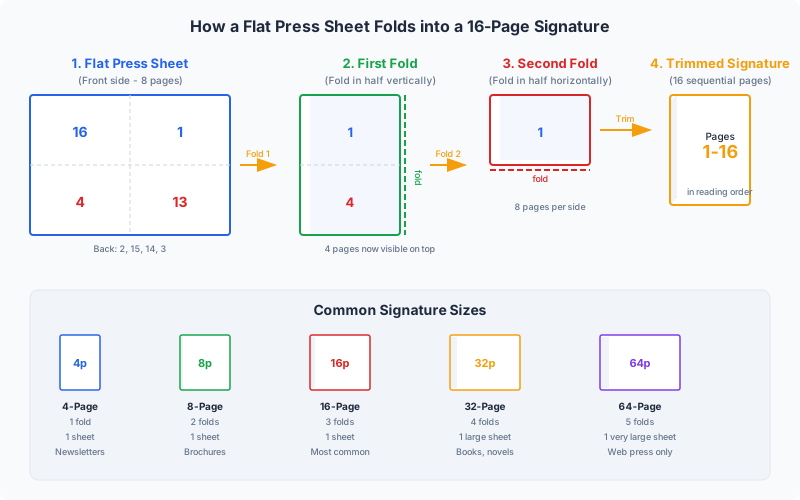
In this guide, we will explore the mechanics of 32-page signatures in detail: the two primary configurations (four 8-page or two 16-page signatures versus a single 32-page sheet), page number placement on the flat sheet, the fold sequence that brings pages into order, considerations for perfect binding, creep compensation, and how to set up 32-page prepress using PDF Press. Whether you are producing a paperback novel, a product catalog, or an academic journal, this knowledge will help you prepare files correctly and communicate effectively with your printer.
Anatomy of a 32-Page Signature
A 32-page signature is created from a single press sheet printed on both sides (16 pages per side) and folded four times. To understand the layout, let's start with the physical sheet and work inward through each fold.
The Flat Sheet
Before folding, the sheet lies flat with 16 pages arranged on the front (recto) and 16 on the back (verso). The pages are not in sequential order — they are positioned so that after four folds, they will read in sequence from page 1 to page 32. The arrangement is determined by the folding scheme and is precisely calculated by prepress software.
Page Orientation on the Sheet
Not all pages face the same direction on the flat sheet. Some pages are printed upside down (head-to-foot rotation) so that they are right-side up after folding. In a 32-page signature, exactly half the pages on each side are rotated 180 degrees. This is not an error — it is a fundamental requirement of the folding process. If you examine a press sheet before folding, seeing inverted pages is completely normal.
The Four Folds
The signature is created through four sequential folds:
- First fold: The sheet is folded in half along its longest dimension, reducing it to a 16-page unit (8 pages per side of the folded sheet)
- Second fold: The once-folded sheet is folded in half again perpendicular to the first fold, creating an 8-page unit
- Third fold: Another perpendicular fold creates a 4-page unit
- Fourth fold: The final fold creates the finished 32-page signature with pages in reading order
After folding, the top fold and the right (face) fold are trimmed open to create free pages that can turn independently. The spine fold (left edge) remains intact and will be bound — either by perfect binding adhesive or by sewing thread in case-bound (hardcover) books.
Page Number Mapping
The relationship between page numbers and their positions on the flat sheet follows a specific mathematical pattern. For a standard 32-page right-angle fold signature, the page pairs on each panel (front and back of the same physical position) always sum to 33 (the total page count plus one). So page 1 backs onto page 32, page 2 backs onto page 31, page 16 backs onto page 17, and so on. This sum-to-N+1 rule is a reliable check for verifying correct prepress.
32-Page Configurations: Full Sheet vs. Split Signatures
There are three primary ways to produce a 32-page section, and the right choice depends on your press size, paper weight, and binding method.
Configuration 1: Single 32-Page Signature (One Sheet, Four Folds)
The most efficient option when your press can handle it. One large sheet (typically 25"x38" or larger) is printed with all 32 pages and folded four times. This produces the fewest number of components for gathering and binding, which speeds up the binding line and reduces the chance of gathering errors.
Advantages:
- Maximum press efficiency — one sheet, one plate set, one pass per side
- Fewest components in the binding line
- Lowest per-signature cost at volume
Disadvantages:
- Requires a large-format press (minimum 25"x38" sheet for standard book page sizes)
- Four folds create a thick fold — paper weight must be moderate (typically under 80 gsm / 60lb text)
- The fourth fold can be imprecise on heavier stocks, causing page registration issues
Configuration 2: Two 16-Page Signatures
The 32 pages are divided into two 16-page signatures, each printed on a separate (smaller) sheet and folded three times. The two signatures are then gathered in order during binding. This is the most common approach for medium-format presses.
Advantages:
- Works on standard commercial presses (20"x26" sheets for typical book sizes)
- Three folds instead of four — cleaner folding, better registration, accommodates heavier papers
- More flexible for page count variations (can easily accommodate 24, 40, 48 pages by mixing 16-page and 8-page signatures)
Disadvantages:
- Two sheets instead of one — more plate sets, more press makeready
- Two components per 32-page section in the binding line
Configuration 3: Four 8-Page Signatures
The 32 pages are divided into four 8-page signatures, each printed on a smaller sheet and folded twice. This approach is used for small-format presses, very heavy paper stocks, or when economic constraints limit press size.
Advantages:
- Works on the smallest commercial presses
- Only two folds — excellent fold quality even on heavy stock (100+ gsm / 80lb text)
- Maximum flexibility for mixed page counts
Disadvantages:
- Four plate sets and four press runs for 32 pages
- Four components per section in the binding line — slower gathering, more potential for errors
- Highest cost per page at volume
Most commercial book printers use Configuration 2 (two 16-page signatures) as their standard approach, as it balances press efficiency with fold quality and equipment availability. Configuration 1 is used by large publishers with access to full-size web presses. Configuration 3 is typically reserved for specialty printing or short-run digital book production.
Page Number Placement on the Flat Sheet
Understanding where each page number falls on the flat press sheet is crucial for troubleshooting prepress errors and for manual verification of imposed proofs. While PDF Press calculates these positions automatically, knowing the logic behind the placement helps you catch errors and communicate with press operators.
The Pairing Rule
In any signature, front-and-back page pairs (pages printed on opposite sides of the same physical sheet position) follow the N+1 rule: the two page numbers sum to the total pages in the signature plus one. For a 32-page signature, every pair sums to 33:
- 1 + 32 = 33
- 2 + 31 = 33
- 3 + 30 = 33
- 16 + 17 = 33
Head and Foot Orientation
On the flat sheet, pages alternate between head-up and head-down (rotated 180 degrees) orientation. This alternating pattern ensures that after each fold, all pages end up right-side up. The exact pattern depends on the fold scheme, but a general principle is that pages sharing a fold axis are rotated relative to each other.
A reliable verification method: after folding the first signature from your proof run, check that every page reads correctly when you flip through the folded section. If any page is upside down, there is a prepress error in the head/foot rotation for that position.
Lip and Shingling
After folding, the edges of inner pages extend slightly beyond the edges of outer pages. This projection is called the lip and is deliberately designed so that the gathering machine can grip each signature by its lip to pull it into the gathering line. The lip is trimmed off during the three-knife trim (head, foot, and face cuts) that gives the final book its clean edges.
Verifying Your Prepress
The most reliable way to verify a 32-page prepress is the folding dummy method:
- Take a blank sheet the same size as your press sheet
- Number the positions 1 through 32 on both sides, following your prepress layout
- Fold the sheet following your planned fold sequence
- Trim the head and face folds
- Check that the pages read in sequential order
If the numbering is correct, your prepress is verified. This physical test catches errors that are difficult to spot in a digital preview, particularly rotation errors and fold-sequence mistakes. It takes five minutes and can prevent an expensive reprint.
Fold Sequences for 32-Page Signatures
The fold sequence — the order and direction of each fold — determines the final page arrangement. Different fold sequences produce different page layouts on the flat sheet, even for the same 32-page signature. The two most common fold types for 32-page work are right-angle folds and parallel folds.
Right-Angle Fold (Standard Bookwork)
In a right-angle fold sequence, each successive fold is perpendicular to the previous one. This is the standard method for bookwork because it produces a compact, book-like signature that lies flat and can be gathered, sewn, or glued easily.
For a 32-page right-angle signature:
- Fold 1 (horizontal): Sheet folded in half — short edge to short edge — creating 16-page halves
- Fold 2 (vertical): Folded perpendicular to fold 1 — long edge to long edge — creating 8-page quarters
- Fold 3 (horizontal): Folded perpendicular to fold 2 — creating 4-page eighths
- Fold 4 (vertical): Final fold perpendicular to fold 3 — creating the finished 32-page signature
Each fold halves the sheet area and doubles the page count. The alternating horizontal-vertical pattern ensures that the spine fold (for binding) ends up on the correct edge. Buckle folders on modern bindery equipment perform these folds automatically at speeds of 10,000-30,000 sheets per hour.
Parallel Fold Variations
In some configurations, two or more folds are parallel (same direction). Parallel folds are used less often for 32-page signatures because they create a signature with uneven thickness distribution. However, they are sometimes necessary when press or folder equipment constraints dictate specific fold geometries.
A common hybrid is the 3+1 fold: three right-angle folds to create a 16-page section, followed by a parallel fold to bring it to 32 pages. This hybrid is used when the folding equipment cannot handle a four-fold right-angle sequence on the given paper weight.
Web Press vs. Sheet-Fed Fold Considerations
On web presses (which print from rolls of paper rather than pre-cut sheets), the first fold often happens inline as the web is cut and folded by the press's own folding unit. Subsequent folds may be done inline or by a separate offline folder. The prepress for web press work must account for the specific fold configuration of the press's folding unit, which varies by manufacturer. Sheet-fed work has more flexibility because the folding is always done offline on a separate buckle folder or knife folder.
When setting up 32-page prepress in PDF Press, the tool handles fold sequence calculations automatically. You specify the signature size and binding method, and PDF Press arranges pages in the correct positions for standard right-angle folding. For non-standard fold schemes, the Expert Grid tool provides manual control over every page position and rotation.
Perfect Binding Considerations for 32-Page Signatures
The 32-page signature is most commonly associated with perfect binding, the binding method used for paperback books, thick magazines, and substantial catalogs. Perfect binding has specific requirements that affect how 32-page signatures are imposed and produced.
Spine Preparation
In perfect binding, the spine fold of each signature is ground off (milled) to create a rough surface for adhesive bonding. This means the spine fold does not remain intact — unlike saddle stitch, where the fold is the binding mechanism. The implication for prepress is that content should not extend into the spine fold area, as a few millimeters of paper are removed during spine milling. Most book designers add a 3-5mm safety margin at the spine edge specifically for this reason.
Signature Gathering Order
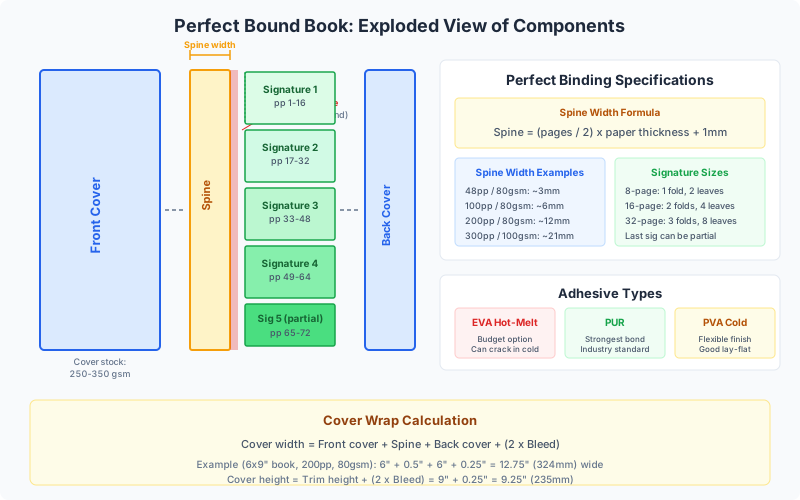
A perfect-bound book is assembled by gathering signatures in sequence: signature 1 (pages 1-32), signature 2 (pages 33-64), signature 3 (pages 65-96), and so on. Each signature must be imposed independently, with its own page arrangement calculated based on its position in the book. The prepress for signature 1 is different from signature 3 not because the fold sequence changes, but because the page numbers are different.
Spine Width Calculation
A critical pre-production step is calculating the spine width, which depends on the total number of pages and the paper thickness (caliper). The formula is:
Spine width = Number of pages x Paper caliper / 2
For a 256-page book on 80 gsm offset paper (caliper approximately 0.1mm per sheet):
Spine width = 256 x 0.1 / 2 = 12.8mm
This spine width must be communicated to the cover designer, who needs it to create the cover wrap (front cover + spine + back cover as a single piece). An incorrectly calculated spine width results in a cover that doesn't fit — either too tight (causing the book to curve) or too loose (leaving a gap at the spine).
Crossover Considerations
Crossovers (images or design elements that span across two facing pages) are particularly challenging with 32-page signatures. Within a signature, pages that are physically adjacent on the press sheet may not be adjacent in the bound book. A crossover between pages 16 and 17 (the center spread of a 32-page signature) works well because these pages are printed on opposite sides of the same sheet position and will align precisely. But a crossover between pages 32 and 33 (the join between two signatures) requires perfect signature-to-signature alignment, which is difficult to guarantee. Book designers should minimize crossovers at signature boundaries.
Creep Is Not a Factor
Unlike saddle stitch binding, perfect binding does not suffer from creep. Because signatures are gathered (stacked) rather than nested (placed inside each other), there is no progressive push-out of inner pages. Each signature is trimmed independently at the spine before binding, so all pages maintain their intended margins regardless of their position within the signature.
Creep in 32-Page Saddle-Stitched Booklets
While 32-page signatures are most commonly used in perfect binding, they can also be saddle stitched as standalone 32-page booklets. In this configuration, all 32 pages are nested inside each other (like a magazine), and creep becomes a significant quality concern.
Quantifying Creep in a 32-Page Booklet
A 32-page saddle-stitched booklet requires 8 nested sheets. Assuming standard 80 gsm paper with a caliper of approximately 0.1mm per sheet, the total creep at the innermost sheet is:
Maximum creep = (Number of sheets - 1) x Paper caliper = 7 x 0.1mm = 0.7mm per side
That means the innermost pages (pages 16-17) shift approximately 0.7mm outward compared to the outermost pages (pages 1-32). After trimming to a clean face edge, those inner pages lose 0.7mm more content than the outer pages. On heavier paper (100 gsm, caliper ~0.13mm), the creep increases to approximately 0.9mm — nearly a full millimeter of differential trim.
Visual Impact of Uncompensated Creep
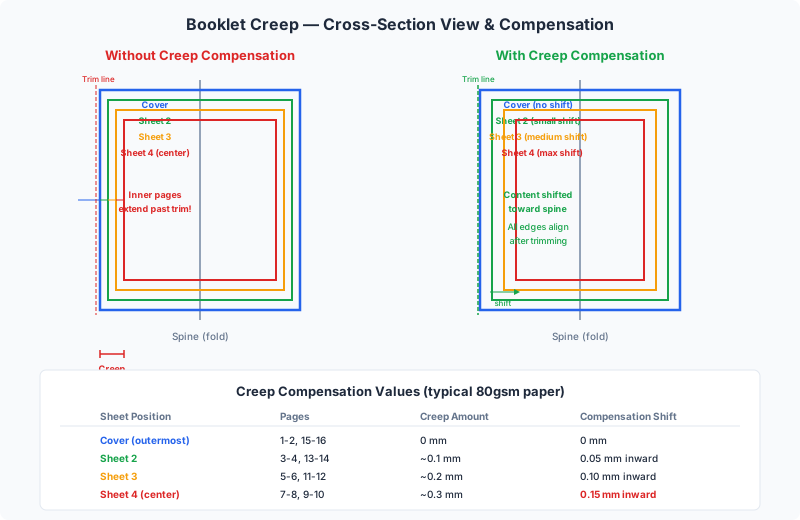
At 0.7-0.9mm, creep is clearly visible to the naked eye. The most noticeable symptom is uneven margins: outer pages have wider face margins (the margin at the open edge opposite the spine), while inner pages have narrower face margins. If the design includes elements positioned relative to the page edge — running headers, page numbers, decorative borders — the misalignment is particularly obvious.
Compensating for Creep
Creep compensation works by progressively shifting content on each page toward the spine, with the shift amount increasing from the outermost pages (no shift) to the innermost pages (maximum shift). The result after trimming is visually even margins across all pages.
The compensation formula for each sheet is:
Shift = ((Sheet position from outside - 1) / (Total sheets - 1)) x Maximum creep
For an 8-sheet (32-page) booklet with 0.7mm total creep:
- Sheet 1 (outermost, pages 1/2/31/32): 0mm shift
- Sheet 2 (pages 3/4/29/30): 0.1mm shift
- Sheet 3 (pages 5/6/27/28): 0.2mm shift
- Sheet 4 (pages 7/8/25/26): 0.3mm shift
- Sheet 5 (pages 9/10/23/24): 0.4mm shift
- Sheet 6 (pages 11/12/21/22): 0.5mm shift
- Sheet 7 (pages 13/14/19/20): 0.6mm shift
- Sheet 8 (innermost, pages 15/16/17/18): 0.7mm shift
PDF Press applies creep compensation automatically when you set up a saddle stitch booklet, calculating the correct shift for each page based on the number of sheets. You can also adjust the paper thickness parameter to match your specific stock for more accurate compensation.
32-Page Signatures in Commercial Book Production
In commercial book manufacturing, the 32-page signature is the standard building block. Understanding how it fits into the larger production workflow helps you prepare files correctly and avoid costly mistakes.
Signature Planning
The first step in book production is dividing the total page count into signatures. The goal is to use the fewest signatures possible (to minimize press runs and gathering operations) while staying within the fold limitations of your paper stock. A typical plan for a 288-page book:
- Nine 32-page signatures = 288 pages
- Or: Eight 32-page signatures + two 16-page signatures = 288 pages
- Or: Eighteen 16-page signatures = 288 pages
The optimal plan depends on press size, paper weight, and the printer's equipment. Most book printers prefer 32-page or 16-page signatures for the body of the book, with smaller signatures (8-page or even 4-page) used as needed to accommodate page counts that don't divide evenly into the standard sizes.
Partial Signatures
When the total page count doesn't divide evenly into 32, a partial signature is needed. For example, a 300-page book could be:
- Nine 32-page signatures (288 pages) + one 12-page signature (12 pages) = 300 pages
- The 12-page "signature" is actually produced as a 16-page signature with 4 blank pages, trimmed after binding
Alternatively, the book might be reorganized to 304 pages (nine 32-page + one 16-page signature) by adding four blank pages. Adding a few pages is often cheaper than the complications of an odd-size partial signature.
Prepress Marks and Collating Marks
Each signature includes several marks in the non-content area (trimmed off in finishing) that aid production:
- Signature mark (collating mark): A small black rectangle on the spine fold that steps down in position from signature to signature. When signatures are gathered in order, the marks create a staircase pattern that is visible from the spine — a quick visual check that all signatures are present and in the correct order.
- Back-step mark: Similar to the collating mark but used specifically for binding line automation.
- Fold marks: Fine lines or triangles on the sheet edges that indicate where each fold should be made, helping the folder operator set up the buckle plates correctly.
- Plate ID: A small identifier (job number, signature number, date) in the trim area for tracking purposes.
Paper Grain Direction
For book production, the paper grain should run parallel to the spine (grain-long for most book sizes). This allows pages to turn easily and lie flat when the book is open. Grain direction also affects folding quality — sheets fold more cleanly and accurately along the grain than across it. When ordering paper for 32-page signatures, specify grain direction to ensure it aligns with the final fold orientation.
How to Set Up 32-Page Prepress in PDF Press
PDF Press makes 32-page prepress straightforward, whether you are producing a single 32-page booklet or dividing a long book into multiple 32-page signatures. Here is the step-by-step process for both scenarios.
Scenario 1: 32-Page Saddle-Stitched Booklet
- Open PDF Press and upload your 32-page PDF
- Add the Booklet tool from the tool palette
- Select Saddle Stitch as the binding method
- PDF Press automatically arranges all 32 pages in the correct nested order for saddle stitch binding
- Enable creep compensation — this is important for 32-page booklets where 8 sheets are nested
- Set your target paper size (the sheet you will print on — typically A3 or Tabloid for A4/Letter-sized pages)
- Optionally enable crop marks for trimming guides
- Preview the layout — verify that page numbers are correct by checking a few known positions (page 1 should pair with page 32, page 16 should pair with page 17)
- Download the imposed PDF — each sheet in the output represents one physical sheet to be printed double-sided, folded, and nested
Scenario 2: Perfect-Bound Book with 32-Page Signatures
- Open PDF Press and upload your complete book PDF (any page count)
- Add the Booklet tool and select Perfect Binding
- Set pages per signature to 32 — PDF Press divides your book into 32-page sections automatically
- If your total page count doesn't divide evenly by 32, PDF Press adds blank pages to the final signature to complete it
- Preview each signature — PDF Press shows them sequentially in the output. Verify that page numbering is correct at signature boundaries (e.g., signature 1 ends with page 32, signature 2 begins with page 33)
- Choose your press sheet size — for A5 (148x210mm) final trim, a 32-page signature requires approximately an SRA2 (450x640mm) press sheet
- Download the imposed PDF — the output contains all signatures in order, ready for printing, folding, gathering, and binding
Scenario 3: Mixed Signature Sizes
For books with a page count that benefits from mixed signatures (e.g., 288 pages as eight 32-page + one 16-page + one 8-page), you can use PDF Press's pipeline capability. Process the main body with 32-page signatures, then process the remaining pages with smaller signature sizes, and combine the output. The N-up Book tool also provides direct control over signature size with automatic page count adaptation.
In all scenarios, PDF Press provides a real-time preview of the imposed layout. You can scroll through every output sheet, verify page positions and orientations, and confirm correct prepress before downloading — catching errors that would be expensive to discover on press.
Quality Control Checks for 32-Page Prepress
A 32-page signature has 32 individual pages that must each be in the correct position, orientation, and registration. The complexity of the layout makes quality control essential. Here are the verification steps that prepress professionals use to ensure correct prepress before committing to a press run.
The N+1 Pairing Check
As discussed in the page placement section, every front-back page pair should sum to 33 for a 32-page signature. Spot-check several positions on the imposed flat: if page 5 is on the front, page 28 should be on the back of the same position (5 + 28 = 33). If any pair doesn't sum correctly, the prepress has an error.
The Folding Dummy Test
Print the imposed layout on a single sheet (even at reduced size on a desktop printer), fold it following the intended fold sequence, trim the head and face edges, and verify sequential page order. This takes 10 minutes and catches errors that are nearly impossible to spot on a flat proof. For a 32-page signature, this physical test is considered mandatory in professional prepress workflows.
Crossover Alignment
If your design includes crossover images (images spanning two facing pages), verify that the two halves align correctly at the center spread and at any other crossover positions. In a 32-page saddle-stitched booklet, the center spread is pages 16-17. In a perfect-bound 32-page signature, pages 16-17 are also the center of the signature and will align well. Crossovers at other positions depend on whether the two pages are printed on the same sheet position or not.
Head/Foot Rotation Verification
Verify that pages are correctly rotated on the flat sheet. In a 32-page prepress, 16 of the 32 page positions on each side are rotated 180 degrees. Check several positions by mentally "folding" the sheet and confirming that the page would read right-side up after all four folds. A single rotation error means that page will be printed upside down in the final booklet.
Gripper and Guide Edge Margins
Confirm that the imposed layout keeps all content outside the gripper margin and guide edge margins of your press. Content placed too close to these edges will be cut off or print inconsistently. For a 32-page layout on a large sheet, the usable area is significantly smaller than the full sheet dimensions.
Bleed Continuity
For pages with bleed (content extending past the trim edge), verify that the bleed extends fully to the trim line on the imposed flat. Some prepress software clips bleed at fold lines — check that your bleed is preserved through the prepress process, particularly at the spine fold where signatures will be trimmed for perfect binding.
Automated Verification with PDF Press
PDF Press's real-time preview functions as a built-in verification tool. As you scroll through the imposed output, you can visually confirm page numbers, orientations, and content placement. The preview renders the actual WASM-imposed output — not a simulation — so what you see is exactly what will be produced. Combined with a physical folding dummy on the first proof, this workflow catches virtually all prepress errors before they reach the press.
Common Applications of 32-Page Signatures
The 32-page signature is used across a wide range of commercial print products. Understanding these applications helps you select the right signature configuration for your specific project.
Trade Paperbacks and Novels
The standard mass-market paperback novel is produced almost exclusively with 32-page signatures on web offset presses. A typical 320-page novel consists of ten 32-page signatures, perfect bound with a 4-color cover. The economics are compelling: ten press sheets per book (before folding) on a high-speed web press can produce thousands of books per hour. This is the most cost-efficient way to produce long-run book titles.
Product Catalogs
Catalogs ranging from 64 to 500+ pages use 32-page signatures as their primary building block. The large signature size minimizes the number of gathering operations, which is critical for catalog production runs that may reach hundreds of thousands of copies. Catalogs often use 32-page signatures for the body with a separate 4-page or 8-page cover section on heavier stock.
Academic Journals and Proceedings
Academic journals typically run 96 to 192 pages and are composed of 32-page or 16-page signatures. The mathematical nature of signature-based prepress aligns well with the structured format of academic publications, where articles begin on specific pages and section breaks correspond to signature boundaries when possible.
Magazines (Thick Issues)
While thin magazines (under 64 pages) are typically saddle stitched, thick magazine issues — special editions, annual reviews, or premium publications — use perfect binding with 32-page or 16-page signatures. Fashion magazines, architectural digests, and coffee-table-style publications fall into this category.
Training Manuals and Textbooks
Corporate training manuals and educational textbooks are frequently produced with 32-page signatures. These publications benefit from the durability of perfect binding (they'll be handled repeatedly) and the efficient production that 32-page signatures provide for page counts in the 100-400 range.
Children's Books
Picture books and early readers that run 32 pages are sometimes produced as a single 32-page signature, saddle stitched or sewn. The 32-page format is so common for children's books that it has become an industry standard page count, partly because it corresponds to exactly one signature — maximizing production efficiency while providing enough pages for a complete story.
Regardless of the specific application, the 32-page signature offers the best balance of production efficiency and print quality for long-run publications. Combined with modern prepress tools like PDF Press, setting up accurate 32-page prepress is accessible to everyone from independent publishers to large commercial printers.
Try it yourself
PDF Press runs entirely in your browser. Upload a PDF, pick a tool, and download the result — fast and private.
Open PDF Press22 Professional Imposition Tools
Every tool runs locally in your browser — fast, private, and professional-grade.
Frequently Asked Questions
Related Articles
Ready to try professional PDF imposition?
PDF Press is a browser-based imposition tool with 22 professional tools. No installation required.
Open PDF Press